The Road to Tenure and Dr. McGriggs
E
arlier this week I went to visit with the advisor of my club Young Democrats. My advisor, Dr. Mike is also the head of the Political Science Department and is extremely easy to talk to. (If you are a Political Science major, I suggest you acquaint yourself with him). Anyways, we got onto the topic of Professors at the University and somehow Dr. McGriggs was brought into the conversation, I asked Dr. Mike if Dr. McGriggs was a tenured professor and he replied, "no, he signs a contract every year, like everyone else." Which made me wonder why exactly some professors decide to go start on the tenure track and why others don't also, why teachers who have been here as long as Dr. McGriggs have, decide not to become full time professors at all. For those who don't know, a tenured professor is defined as "a senior academics contractual right not to have his or her position terminated without just cause." So does that mean everyone else can be fired just by saying something administration doesn't like? And how many others believe that Tenure shouldn't be determined by whether or not you "wrote a book"? Like who has time to sit and write a book being that the vast majority of teachers already are teaching a million and twelve other classes. I brought this issue up during Dr. Mathison's class and we further discovered that the number of tenured teachers is extremely low at this school because if you are denied "tenure" you are forced to quit that following year. I think I can speak for everyone if you ever consider teaching at the university level the most attractive route would be the "Tenure" route however after learning what I have, that would probably discourage more than most.

More information about tenure can be found here: http://jerz.setonhill.edu/about/tenure/
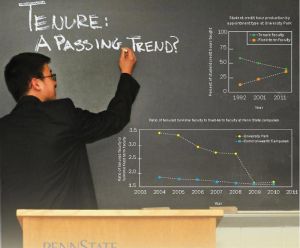

Basically being a university professor on the tenure track is a 6-year audition, where you teach, serve on committees, mentor students, present work at conferences, and publish academic research in the hopes that you can stick around more permanently. Then, once you get tenure, you get more committee work and formal reviews every 5 years to make sure you're not slacking.
ReplyDelete